Release Notes
About Version 3.0
All T1 and TP1 returns can be filed electronically or paper-filed with this version, including forms that were under review in previous versions.
Modifications Made to Version 3.0
Forms, schedules and workcharts added to the program
Federal
T2203 Schedule SK(S12), Saskatchewan Home Renovation Tax Credit (Jump Code: MJ SK S12)
This schedule must be completed instead of the usual Schedule SK(S12) (Jump Code: SK S12) to claim the Saskatchewan home renovation tax credit when filing a return that includes income subject to multiple jurisdictions.
Modifications Made to Forms
Federal
Modifications to the CCA calculation related to Bill C-15
Following the changes proposed in Bill C-15 introduced in the House of Commons on November 18, 2025, the CRA has updated the income and expense statements in which capital cost allowance (CCA) is calculated, notably to take into account the rules for re-accelerated investment incentive property (RIIP) and the new adjustment factors applicable to them. Certain rules relating to accelerated investment incentive property (AIIP) have also been amended.
As a result, the CCA calculation tables in Forms T776 (Jump Code: 776) and T2042 (Jump Code: 2042), T2125 (Jump Code: 2125), T2121 (Jump Code: 2121), T1163 (Jump Code: 1163) and T1273 (Jump Code: 1273) as well as the underlying custom forms used to calculate CCA have been updated to reflect the calculations for AIIP and RIIP.
Revenu Québec has confirmed that the amendments included in Bill C-15 also apply to the corresponding Québec income and expense statements. As such, since the CCA calculation tables in Forms TP-80 (Jump Code: Q80), TP-80.AP (Jump Code: Q80.AP FARMING and Q80.AP FISHING) and TP-128 (Jump Code: Q128) will not be updated for the 2025 tax year, the calculation in the following columns has been modified and takes into account the calculations for RIIP:
-
3.1, Cost of acquisitions in column 3 that are accelerated investment incentive property (AIIP)
-
5.2, UCC adjustment based on AIIP acquired during the taxation year
-
9, CCA
-
10, UCC at the end of the year
GSTC, Goods and Services Tax Credit (Jump Code: GSTC)
The government is introducing the new Canada Groceries and Essentials Benefit, formerly known as the goods and services tax (GST) credit. This benefit will be increased by 25% for five years starting in July 2026.
In addition, the government is offering a one-time payment equivalent to a 50% increase this year. The month used to calculate the one-time payment is January 2026 and the reference tax year for calculating income is the 2024 tax year.
In the program, the credit rates have been changed, but the name will not be changed this year. The one-time payment will not be reflected in the program due to the late announcement.
GST370, Employee and Partner GST/HST Rebate Application (Jump code: GST-370)
Nova Scotia has reduced its harmonized sales tax (HST) rate from 15% to 14%, effective April 1, 2025. This change results from a 1% reduction in the provincial component (9% provincial + 5% federal).
As a result, Forms GST370 and Allocation of Expenses for the GST/HST Rebate (Jump Code: GST 370 EXPENSES) have been updated to calculate eligible expenses at the 14% rate for Nova Scotia residents. Updates have also been made to various forms, notably Forms T2042 (Jump Code: 2042), T2121 (Jump Code: 2121), T2125 (Jump Code: 2125), Calculating Vehicle Expenses for Business Use Purposes (Jump Codes: 2042 AUTO, 2121 AUTO and 2125 AUTO), Allowable Motor Vehicle Expenses (Jump Code: 777 AUTO) and the Partner’s Income and Expenses Workchart (Jump Code: PARTNER), to calculate eligible expenses at the 14% tax rate.
T1206, Tax on Split Income (Jump Code: 1206)
Alberta and Nova Scotia have been added as provinces covered by section Tax on split income for multiple jurisdictions, province or territory with an income allocation that is not your province or territory of residence (lines 78 to 92 of Form T1206).
T5013, Statement of Partnership Income (Jump Code: T5013)
For the purposes of the 2025 tax year calculations, periods 1 and 2 are no longer necessary and the following changes have been made:
-
Box 156 is no longer duplicated;
-
The lines for entering split income are no longer separated into periods (before June 25, 2024, and after June 24, 2024).
T2048, Capital Gains Deduction for Qualifying Business Transfers or Qualifying Cooperative Conversions (Jump Code: 2048)
Due to the update of the T5013 slip, it is important to review the information entered in the files created with versions 1.0 and 2.0, as some data may have been lost when opening these files in version 3.0.
Québec
RL-15 Slip, Statement of Partnership Income (Jump Code: T5013)
Capital gains inclusion rate
For the purposes of the 2025 tax year calculations, periods 1 and 2 are no longer necessary and the following boxes have been deleted:
-
12-14;
-
12-16;
-
45-1;
-
45-2.
Cryptoassets
The three following boxes relating to cryptoassets have been added:
-
1-12, Net business income (or loss) from cryptoassets;
-
12-17, Capital gains (or losses) from cryptoassets;
-
14-7, Gross business income from cryptoassets.
Since there is no equivalent box at the federal level, any amount entered in one of these boxes will reduce the amount in the appropriate box of the RL-15 slip according to the type of income.
An amount entered in box 1-12 will reduce the amount of one of the other boxes 1, as applicable:
-
1-1, Net business income (or loss), other than income from farming, fishing or a profession, or from work remunerated on a commission basis;
-
1-2, Net farm income (or loss);
-
1-3, Net fishing income (or loss);
-
1-4, Net professional income (or loss);
-
1-5, Net income (or loss) from work remunerated on a commission basis;
-
1-12, Net business income (or loss) from cryptoassets.
An amount entered in box 14-7 will reduce, as applicable, the amount of one of the other boxes 14:
-
14-1, Gross business income (other than gross income covered by codes 14-2 through 14-6);
-
14-2, Gross farming income;
-
14-3, Gross fishing income;
-
14-4, Gross professional income;
-
14-5, Gross income from work remunerated on a commission basis;
-
14-7, Gross business income from cryptoassets.
As for box 12-17, only the amount in box 12-1 will be reduced by the amount entered in that box.
British Columbia
BC428, British Columbia Tax (Jump Code: BC 428)
In its 2026 budget, the Government of British Columbia has announced that effective for the 2026 and subsequent taxation years, the lowest personal income tax rate will be increased from 5.06% to 5.60%. The applicable percentage for the basic personal income tax credits will also be increased from 5.06% to 5.60%. The maximum amount for the British Columbia tax reduction credit will be increased by $115, reaching $690. The amount of income an individual will be able to claim for the tax credit for volunteer firefighters and search and rescue volunteers will be increased from $3,000 to $6,000. This will increase the maximum tax credit that may be claimed from $168 to $336.
These changes have been integrated in the current version of the program but are only available in Planner Mode or for early-filed returns.
Modifications Made to Version 2.0
Forms, schedules and workcharts added to the program
Québec
TP-80.AP, Statement of Farming Activities (Jump Code: Q80.AP FARMING); and
TP-80.AP, Statement of Fishing Activities (Jump Code: Q80.AP FISHING)
Starting in the 2025 taxation year, farming or fishing income and expenses must be reported using the new TP-80.AP forms for the Québec tax return (Jump Code: TP1).
These new forms have replaced the Q2042 form (now known as the Q80.AP FARMING form) and the Q2121 form (now known as the Q80.AP FISHING form).
Therefore, the former Q2121 and Q2042 forms have been modified to match the new TP-80 AP forms.
If the tax return is paper-filed, farming or fishing income and expenses will be reported in the TPF-1.Y keying summary (Jump Code: Q80 TPFY).
Finally, if the return is electronically transmitted, farming or fishing income and expenses will be transmitted to Revenu Québec.
TP-1079.8.BE, Foreign Property Return (Jump Code: Q1079.8.BE)
This form is equivalent to Form T1135 (Jump Code: 1135) for Québec.
The information entered in Form T1135 is reported into Form TP-1079.8.BE. This form is included in the electronic transmission of the TP1 return (Jump Code: TP1).
For more information, consult the Help.
Modifications Made to Forms
Federal
Capital gains
Increase in the inclusion rate
For the purposes of calculations for the 2025 tax year, periods 1 and 2 are no longer necessary and have been removed from various forms.
Indexation of the capital gains deduction limit (gains realized before June 25, 2024, reported in 2025 by a partnership or trust)
Under Bill C-15, gains realized before June 25, 2024, reported in 2025 by a partnership or trust are subject to indexation of the capital gains deduction limit.
T3 Slip, Statement of Trust Income (Jump Code: T3); and
T5013 Slip, Statement of Partnership Income (Jump Code: T5013)
In order to use the limit when calculating the capital gains deduction, gains eligible for the capital gains deduction are presented as follows:
T3 slip
-
Box 55 (before June 25, 2024)
-
Box 55 (after June 24, 2024)
-
Box 57 (before June 25, 2024)
-
Box 57 (after June 24, 2024)
T5013 slip
-
Box 153 (before June 25, 2024)
-
Box 276 (after June 24, 2024)
-
Box 154 (before June 25, 2024)
-
Box 277 (after June 24, 2024)
-
Box 155 (before June 25, 2024)
-
Box 278 (after June 24, 2024)
T657, Calculation of Capital Gains Deduction (Jump Code: 657)
The table for 2025 consists of two parts:
-
Part 1 – QFFP and QSBCS disposed before June 25, 2024, reported in 2025 (maximum of $522,145)
-
Part 2 – QFFP and QSBCS reported in 2025, excluding those disposed before June 25, 2024 (maximum of $625,000)
Qualifying business transfers (QBT) and qualifying cooperative conversions (QCC)
Since 2024, a new capital gains deduction for qualifying business transfers (QBT) has been available. Bill C-15, published in November 2025, extends the deduction to qualifying cooperative conversions (QCC) and sets out the provisions relating to this new measure. The impacts in the program relating to QBT and QCC are as follows:
-
T2048, Capital Gains Deduction for Qualifying Business Transfers or Qualifying Cooperative Conversions (Jump Code: 2048)
Several lines have been added to reflect Bill C-15 for calculating the allowable deduction. Due to the many changes made to Form T2048 in version 2.0 of the program, it is important to review the information entered in the files created with version 1.0, as some data may have been lost when opening these files in version 2.0.
-
T2048 SUM, Capital Gains Deduction for Qualifying Business Transfers or Qualifying Cooperative Conversions (Jump Code: 2048 SUM)
The new Form T2048 SUM displays a summary of eligible deductions eligible qualifying business transfers (QBT) or qualifying cooperative conversions (QCC).
-
T5013 Slip, Statement of Partnership Income (Jump Code: T5013); and
T3 Slip, Statement of Trust Income (T3)
Checkboxes and drop-down lists have been added to the T5013 and T3 slips to identify QBT or QCC (QBT/QCC on QSBCS, QBT/QCC on QFFP and QBT/QCC for property other than QSBCS or QFFP).
-
Allowable Business Investment Losses – Federal (Jump Code: ABIL)
Addition of a line to indicate the QBT/QCC deduction claimed when calculating the reduction attributable to capital gains deductions.
For residents of Québec, Form TP-232.1 (Jump Code: Q232.1) contains the same addition.
-
Capital Loss Claimed in the Year of Death – Federal (Jump Code: LOSSD)
Addition of the QBT/QCC deduction claimed, including in the year of death, for the calculation of the amount deductible from income other than capital gains.
T2017, Summary of Reserves on Dispositions of Capital Property (Jump Code: 2017)
Addition of separate sections to consider provisions:
-
for dispositions of qualified farm or fishing property (QFFP) under a QBT (previous years – after 2023)
-
for dispositions of qualified farm or fishing property (QFFP) under a QCC (previous years – after 2023)
-
for dispositions of qualified farm or fishing property (QFFP) under a QBT (current year)
-
for dispositions of qualified farm or fishing property (QFFP) under a QCC (current year)
-
for dispositions of qualified small business corporation shares (QSBCS) under a QBT (previous years – after 2023)
-
for dispositions of qualified small business corporation shares (QSBCS) under a QCC (previous years – after 2023)
-
for dispositions of qualified small business corporation shares (QSBCS) under a QBT (current year)
-
for dispositions of qualified small business corporation shares (QSBCS) under a QCC (current year)
-
for dispositions of property (other than QSBCS and QFFP) under a QBT (previous years – after 2023)
-
for dispositions of property (other than QSBCS and QFFP) under a QCC (previous years – after 2023)
-
for dispositions of property (other than QSBCS and QFFP) under a QBT (current year)
-
for dispositions of property (other than QSBCS and QFFP) under a QCC (current year)
T936, Calculation of Cumulative Net Investment Loss (CNIL) to December 31, 2025 (Jump Code: 936)
Lines have been added to consider a QBT or QCC in the calculations of Part 3 and Chart A.
T657, Calculation of Capital Gains Deduction (Jump Code: 657)
Under Bill C-15, taxpayers must claim deductions for a QBT or QCC before claiming the capital gains deduction. Therefore, to avoid double claiming on the same gain, lines for entering amounts related to QBT and QCC have been included on Form T657.
Provisions from T3 slip
The provisions shown in box 30 of the T3 slip (Jump Code: T3) now relate directly to lines 10700 and 11000 of Schedule 3 (Jump Code: 3); they were previously included in Form T2017 (Jump Code: 2017).
Modifications to the CCA calculation related to Bill C-15
Following the changes proposed in Bill C-15 introduced in the House of Commons on November 18, 2025, the CRA has updated the income and expense statements in which capital cost allowance (CCA) is calculated, notably to take into account the rules for re-accelerated investment incentive property (RIIP) and the new adjustment factors applicable to them. Certain rules relating to accelerated investment incentive property (AIIP) have also been amended.
As a result, the CCA calculation tables in Forms T776 (Jump Code: 776) and T2042 (Jump Code: 2042), T2125 (Jump Code: 2125), T2121 (Jump Code: 2121), T1163 (Jump Code: 1163) and T1273 (Jump Code: 1273) as well as the underlying custom forms used to calculate CCA have been updated to reflect the calculations for AIIP and RIIP.
Note: The Canada Revenue Agency (CRA) has informed us that further changes will be made to the calculation of CCA in certain tax forms (T2125, T2042, T2121, T776, T1163, T1273 and PARTNER). Pending the release of final versions, the CRA has asked us to place a Under Review watermark on each of the forms mentioned above. The equivalent Québec forms are also being reviewed. These forms will be available for filing in the next version of the program, which will be available in early March.
Revenu Québec has confirmed that the amendments included in Bill C-15 also apply to the corresponding Québec income and expense statements. As such, since the CCA calculation tables in Forms TP-80 (Jump Code: Q80), TP-80.AP (Jump Code: Q80.AP FARMING et Q80.AP FISHING) and TP-128 (Jump Code: Q128) will not be updated for the 2025 tax year, only the calculation in columns 9, Capital Cost Allowance, and 10, UCC at the end of the year, is performed correctly, taking into account the calculations for RIIP.
Changes related to the addition of depreciable property class
The following capital cost allowance class is now available in the program:
-
Class 1.4 (10%): New purpose-built residential rental if construction began after April 15, 2024, and before 2031;
Therefore, Forms T776 (Jump Code : 776 CCA CLASS), T2042 (Jump Code : 2042 CCA CLASS), T2125 (Jump Code : 2125 CCA CLASS), T2121 (Jump Code : 2121 CCA CLASS) et T1163 (Jump Code : 1163 CCA CLASS) allow you to select this class when necessary.
Alternative minimum tax
Due to Bill C-15, investment counsel fees are now considered deductible expenses at a rate of 50% for the purpose of calculating the alternative minimum tax (AMT). In addition, Bill C-15 provides for the exclusion of a class of property consisting of flow-through shares from capital gains on gifts of publicly listed securities included at a rate of 30% in the calculation of the AMT.
These changes are reflected in the program as follows:
T691, Alternative Minimum Tax (Jump Code: 691)
-
The line Investment counsel fees has been added to Part 1 to limit the expense.
-
A line allowing the amount from line 68231 of Form T1170 (Jump Code: 1170) to be carried forward has been added to the line Capital gains on gifts of publicly listed securities to allow for its exclusion.
Statement of Investment Income, Carrying Charges and Interest Expenses (Jump Code: INVESTMENTS)
-
A separate line, Investment counsel fees, has been added to enter the amount subject to the limitation.
T1170, Capital Gains on Gifts of Certain Capital Property (Jump Code: 1170)
-
Line 68231 has been added to allow the exclusion of gains from a class of property consisting of flow-through shares in the calculation of the AMT.
Designated immediate expensing property (DIEP)
The immediate expensing measure has ended on December 31, 2024. Any property that becomes available for use in a taxation year after 2024 is no longer eligible.
DIEP will not be calculated in the self-employment forms (T2042, T2121, T2125, T1163, T1273 and T776) for acquisitions made in 2025. This change has also been applied in the equivalent Québec forms.
Non-refundable top-up tax credit (Jump Code: FED CREDITS)
The federal government has introduced a non-refundable top-up tax credit to prevent certain taxpayers from being disadvantaged by the gradual reduction in the first federal tax rate (from 15% to 14.5% in 2025, then to 14% in 2026). Indeed, since the value of non-refundable tax credits is calculated based on the first rate, a decrease in this rate automatically reduces the value of these credits. In some cases, this could negate or even exceed the benefit provided by the tax reduction. When necessary, the top-up tax credit helps maintain a value equivalent to 15% for non-refundable tax credits on the portion of income that exceeds the first tax bracket ($57,375 in 2025). This measure is temporary and applies for the 2025 to 2030 taxation years.
Schedule 15, FHSA Contributions, Transfers, and Activities (Jump Code: 15)
For the 2025 year, multiple lines have been added:
-
Total contributions made to your FHSAs in 2024 (from your 2025 FHSA participation room statement)
-
Contributions to your FHSAs in 2024 before your first qualifying withdrawal (from your 2025 FHSA participation room statement)
-
Variable "H" amount of your annual FHSA limit for 2024 (from your 2025 FHSA participation room statement)
-
Variable "F" amount of your annual FHSA limit for 2024 (from your 2025 FHSA participation room statement)
GST370, Employee and Partner GST/HST Rebate Application (Jump code: GST-370)
Nova Scotia has reduced its harmonized sales tax (HST) rate from 15% to 14%, effective April 1, 2025. This change results from a 1% reduction in the provincial component (9% provincial + 5% federal). Please note that Form GST370 is currently under review in version 2. The 2025 update will be included in the next version of the program, which is scheduled for release in early March 2026. This version will reflect the new 14% HST rate applicable in Nova Scotia.
ACB, Tracking the Adjusted Cost Base (Jump Code: ACB)
The Crypto-assets asset category has been added to the Asset category drop-down list following the addition of section Crypto-assets to Schedule 3 (Jump Code: 3).
If you have transactions related to crypto-assets rolled forward from last year that are using the Bonds, debentures, promissory notes, crypto-assets and other similar properties asset category, we recommend that you transfer these transactions in a separate copy using the new Crypto-assets asset category.
T1028, RRSP/PRPP/FHSA Information or Notice of Assessment (Jump Code: 1028)
The following lines have been added to Form T1028 to allow the amounts to be entered:
-
Total contributions made to your FHSAs in 2024 (from your 2025 FHSA participation room statement)
-
Contributions to your FHSAs in 2024 before your first qualifying withdrawal (from your 2025 FHSA participation room statement)
-
Variable "H" amount of your annual FHSA limit for 2024 (from your 2025 FHSA participation room statement)
-
Variable "F" amount of your annual FHSA limit for 2024 (from your 2025 FHSA participation room statement)
T2038, Investment Tax Credit (Individuals) (Jump Code: 2038)
The section Recapture – ITC for child care spaces has been removed from Part C of Form T2038 given that child care spaces are no longer eligible for the investment tax credit (ITC) since 2020.
T2043, Return of Fuel Charge Proceeds to Farmers Tax Credit (Jump Code: 2043)
The 2025 tax year is the last year in which Form T2043 can be used to claim the return of fuel charge proceeds to farmers tax credit. The credit remains in effect for the 2025 tax year, but it is only available if the fiscal period begins in 2024 and ends in 2025.
Any business with a fiscal period beginning on or after January 1, 2025, is not eligible for the credit.
Québec
TP-21.4.39, Cryptoasset Return (Jump Code: Q21.4.39)
Part Rental income (or losses) from cryptoassets has been removed.
Two types of cryptossets have been added: Private cryptocurrency and Stablecoins. These types have also been integrated into the cryptoasset options of Schedule 3 (Jump Code: A3).
TP-128 – Income and Expenses Respecting the Rental of Immovable Property (Jump Code: Q128)
With the update of these forms, the calculation of net rental income before capital cost allowance has been modified to exclude expenses attributable to non-compliant short-term rentals.
There are several changes to Part Net rental income (or net rental loss) before capital cost allowance, including:
-
The addition of a line to identify income from short-term rentals. When the form is applicable, this amount is equal to the amount on line 8140 of Form T776 (Jump Code: 776).
-
The addition of column C, Portion attributable to short-term expenses, to the expense table. When the form is applicable, the values in this column are calculated based on the inputs of the Short-term rental portion of total expenses column in Part 4 of Form T776.
In addition, Part Non-compliant short-term rental expenses has been added to the forms. When the forms are applicable, this part is completed using the information entered in tables A and B of Form T776. The Add and Delete buttons are available because the laws governing short-term rentals in Québec differ from federal laws.
Finally, Part Capital cost allowance has also been modified. Column 9 now represents CCA before adjustment for non-compliant short-term rental expenses. Columns 9.1, CCA for non-compliant short-term rentals, and 9.2, CCA, have been added. Capital cost allowance corresponds to the total in column 9.2.
TP-776.42, Alternative Minimum Tax (Jump Code: Q776.42)
Section 8, Tax credits transferred by your spouse, has been added to the form.
Forms removed
Federal
-
24901 – Additional Security Options Deduction
Calculations and Forms Not Available or Under Review
Forms Under Review
You can access the forms under review from the Form Manager. Although these forms are functional, they have not yet been updated for 2025. The following forms are presently under review for one of the following reasons: either the CRA has not yet released the final version, or we have received the form too late to integrate it.
Forms under review:
-
Forms relating to mining exploration, resources and RS&ED tax credits
-
Forms relating to provincial and territorial taxes for multiple jurisdictions situations
-
Forms relating to foreign tax credits
-
T1206 and TP-766.3.4 – Tax on Split Income
-
T5013, Statement of Partnership
-
GST-370 and GST DEPENSES – GST/HST Rebate Application
-
TP-726.7, Capital Gains Deduction on Qualified Property
Notes
-
The Canada Revenue Agency (CRA) has informed us that further changes will be made to the calculation of CCA in certain tax forms (T2125, T2042, T2121, T776, T1163, T1273 and PARTNER). Pending the release of final versions, the CRA has asked us to place a Under Review watermark on each of the forms mentioned above. The equivalent Québec forms are also being reviewed. These forms will be available for filing in the next version of the program, which is scheduled to be released in early March.
-
Form TP-726.7, Capital Gains Deduction on Qualified Property, is currently being analyzed by Revenu Québec. Therefore, a Under Review watermark has been added to the form. We are still awaiting official confirmation from Revenu Québec regarding the definitive addition of the $522,145 ceiling as a result of the federal government's Bill C-15. This form will be available for filing in the next version of the program, which is scheduled to be released in early March.
Modifications Made to Version 1.0
Forms, schedules and workcharts added to the program
Québec
LM-91, Self-declaration Relating to the Application of the Charter of the French Language (Jump Code: QLM-91)
This form is intended for individuals (or individuals in business) who wish to receive services from Revenu Québec in English, in accordance with an exception provided for in the Charter of the French Language. As a general rule, Revenu Québec must communicate with its clients in French only, with some exceptions.
You must complete the form if you are covered by one of the exceptions below:
-
Individuals eligible for English-language education in Québec;
-
Indigenous persons (members of the 11 nations recognized in Québec);
-
Individuals whose primary residence is not in Québec;
-
Immigrants admitted to Canada (except temporary workers) may receive services in English for six months only, after which the services will be automatically provided in French.
You do not have to complete the form if Revenu Québec was already communicating with you in English before May 13, 2021 (acquired right).
Saskatchewan
Saskatchewan Home Renovation Tax Credit (Jump Code: SK S12)
A non-refundable home renovation tax credit has been introduced. Saskatchewan homeowners may save up to $420 annually in provincial income tax by claiming a 10.5% tax credit on up to $4,000 of eligible home renovation expenses. Those who are 65 years old and over at the end of the year may save up to $525 annually, based on maximum eligible home renovation expenses of $5,000.
Modifications Made to Forms
Client letters
The Québec letters have been updated to include the following changes:
-
Form LM-91 has been added as a form to be signed in the client letter.
-
A paragraph confirming that the taxpayer has not received, held or disposed of cryptoassets during the year has been added to the Québec client letters. This paragraph is displayed when box 24 of the TP-1 return is selected to No.
-
Updates have been made to the letters in version 1.0 to take into consideration the new Form TP-1079.8.BE, Foreign Property Return, to be signed, despite the form not being available until version 2.0.
Federal
Direct Deposit Tracking (Jump Code: DD)
The CRA no longer accepts direct deposit enrolments or changes made with EFILE tax software. The sole purpose of this form is now to track the direct deposit information rolled forward from prior years. The name of the form has been modified to reflect this change.
For more information on the direct deposit, visit:
Benefits – Changes to child benefits and abolition of the carbon tax (Jump Codes: CCB, PROV BEN and GSTC)
Several changes have been made to benefits.
CCB and PROV BEN
First, the Canada child benefit (CCB) is now paid for 6 months following the death of a child. As a result of the federal announcement, the provinces below have harmonized their child benefits:
-
Ontario – Ontario child benefit
-
British Columbia – BC family benefit
-
Yukon – Yukon child benefit
-
Nunavut – Nunavut child benefit
-
New Brunswick – New Brunswick child tax benefit
-
Nova Scotia – Nova Scotia child benefit
-
Québec – Family Allowance (the period is 12 months rather than 6 months.)
GSTC
Next, due to the abolition of the carbon tax, the following measures have been removed from the form and client letters:
-
Canada Carbon Rebate
-
British Columbia climate action tax credit
-
Nunavut carbon credit
-
Yukon Government carbon price rebate
-
Northwest Territories cost of living offset
Schedule 3, Capital Gains or Losses (Jump Code: 3)
Periods 1 and 2 have been removed by the CRA.
A section has been added to report the proceeds of disposition and gains (or losses) related to crypto-assets. As a result, these transactions must now be entered in section 6 of Part 3.
Capital gains from certain dispositions of an interest in a partnership subject to a 100% inclusion rate must now be entered in the new field 19890, which is replacing the former field 50410.
Schedule 15, FHSA Contributions, Transfers and Activities (Jump Code: 15)
In order to take into account certain amounts calculated in previous years, several lines have been added to Schedule 15, including two lines relating to the amount of variables F and H of the annual FHSA limit.
T3, Statement of Trust Income (Jump Code: T3)
Deletion of boxes
Since the periods before June 25, 2024, and after June 24, 2024, are no longer necessary in relation to the capital gains inclusion rate but remain relevant in certain situations due to the increase in the lifetime capital gains exemption, numerous changes have been made to the T3 slip.
The following boxes have been deleted:
-
52, 53, 54, 56, 58 and 59
Other boxes have been added:
-
551, 552 and 553 (box 55)
-
571, 572 and 573 (box 57)
T4PS, Statement of Employees Profit Sharing Plan (Jump Code: T4PS)
Deletion of periods 1 and 2 in box 34
The periods before June 25, 2024, and after June 24, 2024, relating to the measure aiming to increase the capital gains inclusion rate announced in 2024, are no longer necessary. As a result, boxes 341a, 341b, 342a, 342b, 343a and 343b have been deleted.
T5, Statement of Investment Income (Jump Code: T5)
Deletion of box 34
The periods before June 25, 2024, and after June 24, 2024, relating to the measure aiming to increase the capital gains inclusion rate announced in 2024, are no longer necessary. As a result, box 34 has been deleted.
T5008, Statement of Securities Transactions (Jump Code: T5008)
Deletion of periods 1 and 2 relating to capital gains
The periods before June 25, 2024, and after June 24, 2024, relating to the measure aiming to increase the capital gains inclusion rate announced in 2024, are no longer necessary. As a result, the lines provided for that purpose have been deleted.
T1028, RRSP/PRPP/FHSA Information or Notice of Assessment (Jump Code: 1028)
In order to calculate Schedule 15 (Jump Code: 15) correctly, substantial information from the previous year is required. This information is included in the notice of assessment for the previous year or in Form T1028 for the current year.
The following lines have been added to enable the roll forward or entry of relevant information:
-
Variable “F” amount of your annual FHSA limit
-
Variable “H” amount of your annual FHSA limit
-
Your FHSA carryforward for 2024
T1141, Information Return in Respect of Contributions to Non-Resident Trusts, Arrangements or Entities (Jump Code: 1141)
Form T1141 has been updated to allow for a joint election to be made so that a single person can file all T1141 returns on behalf of the others when multiple individuals are required to file them.
Boxes have been added to confirm that the information reported in sections A, B, C, and D is supported by supporting documents and to identify the supporting documents that are attached to the form. Questions have been added to page 2 of the form to obtain information about the administration of the trust, the arrangement or the non-resident entity.
T1142, Information Return in Respect of Distributions From and Indebtedness to a Non-Resident Trust (Jump Code: 1142)
Form T1142 has been updated to collect more detailed information on non‑resident trusts and their settlors.
Additional details about the non‑resident trust and its settlors are now requested in section A, and questions regarding the administration of the non‑resident trust have been added to this section.
Boxes have been added to sections A, B and C to confirm that supporting documents related to the information provided are available.
Section D now allows filers to confirm that supporting documents related to sections A, B or C are attached to the form.
Finally, the Japanese yen has been added as a functional currency.
Québec
Schedule H, Tax Credit for Caregivers (Jump Code: QH)
A few changes have been made to Schedule H. These changes are solely related to the layout and have no tax implications.
The grid Reduction Calculation (Lines 259 and 359 of Schedule H) (Jump Code: QH Reduction) for the reduction of the tax credit for a care receiver who turned 18 years old in 2025 has been added to Schedule H.
Revenu Québec has removed Form Tax Credit for Caregivers (Jump Code: Q1029.8.61.64) for a third and/or fourth care receiver. The calculation grid Tax Credit for Caregivers (Additional) (Jump Code: QH ADD) has been created to calculate the credit for a third and/or fourth care receiver.
The grid Reduction Calculation (Lines 259 and 359 of Form TP-1029.8.61.64) (Jump Code: Q1029.8.61.64 RED) for the reduction of the tax credit for a third and/or fourth care receiver who turned 18 years old in 2025 has been replaced by Form Reduction Calculation (Lines 259 and 359 of QH Additional) (Jump Code: QH ADD RED).
Schedule V, Tax Credits for Donations and Gifts (Jump Code: QV)
The tax credit for cultural patronage donations was abolished on March 25, 2025. However, this doesn’t affect the carryforward period for donations made before March 26, 2025.
It remains possible to claim this tax credit for cultural patronage donations made before March 26, 2025 to an eligible cultural organization or a registered museum institution.
Part C of the form has been adjusted to reflect the amendments made to the law. In particular, it specifies that a pledge of donation must have been submitted to the Minister of Culture and Communications no later than March 25, 2025 in order to be eligible.
Request for Direct Deposit (Jump Code: QDD)
Unlike the CRA, Revenu Québec still accepts direct deposit enrolments or changes made with EFILE tax software. As a result, the form has been modified to allow the input without overrides of banking information required for direct deposit with Revenu Québec.
RL-3 Slip, Statement of Investment Income (Jump Code: T5)
Deletion of periods 1 and 2 relating to capital gains
The periods before June 25, 2024, and after June 24, 2024, relating to the measure aiming to increase the capital gains inclusion rate announced in 2024, are no longer necessary. As a result, boxes I-1 and I-2 have been deleted.
RL-16 Slip, Statement of Trust Income (Jump Code: T3)
Deletion of boxes
Since the periods before June 25, 2024, and after June 24, 2024, are no longer necessary in relation to the capital gains inclusion rate but remain relevant in certain situations due to the increase in the lifetime capital gains exemption, numerous changes have been made to the RL-16 slip.
The following boxes have been deleted:
-
A-5, A-6, A-7, A-9, H-4, H-6, H-9, H-10, H-5, H-8 and A-8
Other boxes have been added:
-
H-11, H-22 and H-13 (case H-1)
-
H-21, H-22 and H-23 (case H-2)
-
H-31, H-32 and H-33 (case H-3)
-
H-71, H-72 and H-73 (case H-7)
RL-18 Slip, Statement of Securities Transactions (Jump Code: T5008)
Deletion of periods 1 and 2 relating to capital gains
The periods before June 25, 2024, and after June 24, 2024, relating to the measure aiming to increase the capital gains inclusion rate announced in 2024, are no longer necessary. As a result, the lines provided for that purpose have been deleted.
RL-25 Slip, Statement of Employees Profit Sharing Plan (Jump Code: T4PS)
Deletion of periods 1 and 2 relating to capital gains
The periods before June 25, 2024, and after June 24, 2024, relating to the measure aiming to increase the capital gains inclusion rate announced in 2024, are no longer necessary. As a result, boxes B-2, B-3, C-31, C-41, C-32 and C-42 have been deleted.
TP-752.PC, Tax Credit for Career Extension (Jump Code: Q752.PC)
The form has been updated to reflect the changes announced in the last budget:
-
The age of eligibility has been raised from 60 to 65 years old;
-
The amount of the exclusion of the first dollars of eligible work income has been raised from $5,000 to $7,500;
-
The maximum amount of eligible work income on which the tax credit is calculated has been increased from $11,000 to $12,500.
-
The amount of the reduction threshold has been raised from $40,925 to $56,500;
-
The reduction is now based on net individual income;
-
The applicable reduction rate has been raised from 5% to 7%;
-
The grandfathering rule applicable to workers born before January 1, 1951, has been abolished.
Ontario
ON479, Ontario Credits (Jump Code: ON 479)
Ontario is providing additional support to families who wish to undergo fertility treatment through the new fertility treatment tax credit. This refundable tax credit can cover up to 25% of eligible fertility treatment expenses for Ontario residents, up to a maximum of $5,000 per year. These expenses may include IVF cycles, fertility medications, travel costs for treatment and diagnostic tests.
Alberta
AB428, Alberta Tax and Credits (Jump Code: AB 428)
A tax rate of 8% now applies to the first $60,000 of taxable income. The thresholds for tax brackets exceeding this amount have increased by approximately 2%.
The Alberta supplemental tax credit has been introduced. This credit is equal to 2% of the total amount of certain non-refundable tax credits claimed by an individual that exceeds $60,000. It aims to ensure that Albertans claiming high amounts of non-refundable credits are not disadvantaged by the introduction of the new 8% tax bracket.
Effective July 4, 2025, contributions made to an association of potential candidates qualify for the political contributions tax credit, thus expanding opportunities to support provincial political activities.
General T1, Income Tax and Benefit Return (Jump Code: J)
The section Consent to share contact information – Organ and tissue donor registry has been added to the form.
British Columbia
BC479, British Columbia Credits (Jump Code: BC 479)
The annual limit for the British Columbia venture capital tax credit has increased from $120,000 to $300,000 per individual. This new limit applies only to investments made on or after March 4, 2025.
Effective April 1, 2025, First Nation individuals and persons with disabilities who would have qualified for the Apprenticeship Incentive Grant, had it remained available, are now eligible for a $500 enhanced tax credit for each completed Level 1 or Level 2 of an eligible Red Seal program.
Saskatchewan
Saskatchewan Credits (Jump Code: SK 479)
A refundable fertility tax credit of 50% of eligible expenses, for a maximum credit of up to $10,000, has been introduced.
The maximum amount of the active families benefit for eligible children as well as the income threshold have doubled.
Saskatchewan Graduate Retention Program (Jump Code: RC360)
The maximum lifetime amount of the graduate retention program for individuals graduating on or after October 1, 2024, has increased from $20,000 to $24,000.
Manitoba
MB428, Manitoba Tax (Jump Code: MB 428)
The basic personal amount is now progressively reduced for individuals whose net income exceeds $200,000 and is completely eliminated when the net income reaches $400,000. Moreover, the volunteer firefighters’ amount and the search and rescue volunteers’ amount have been increased to $6,000, bringing the maximum annual credit to $648.
MB479, Manitoba Credits (Jump Code: MB 479)
The former school tax credit for homeowners and the education property tax credit have been replaced with the homeowners affordability tax credit. The renters tax credit has been renamed the renters affordability tax credit. The maximum amount of this credit has been increased to $575 and includes an enhanced supplement of $328 for seniors. A rental housing construction incentive tax credit has also been introduced to support the housing supply in the province.
Finally, the cultural industries printing tax credit, which was initially temporary, has been made permanent. This refundable credit is equal to 35% of eligible printing costs incurred for the production of original Canadian books printed in Manitoba, up to an annual limit of $1.1 million per company.
Nova Scotia
NS428, Nova Scotia Tax (Jump Code: NS 428)
Effective January 1, 2025, the spouse or common-law partner amount, the amount for an eligible dependant and the age amount have increased. The income-based supplement that previously applied to these credits is no longer applicable. The supplement amounts are now included in the base amounts. These credits are now available to all eligible taxpayers, regardless of income. Worksheet NS428 (Jump Code: NS CREDITS) has been adjusted accordingly.
Finally, the tax rate for "other than eligible" dividends has been reduced to 1.5%.
Prince Edward Island
PE428, Prince Edward Island Tax and Credits (Jump Code: PE 428)
As announced in the 2024 provincial budget, tax rates have been lowered for most income brackets, with the exception of the highest bracket, for which the rate has been increased. These adjustments are intended to reduce the tax burden on families and individuals with low or middle incomes in particular.
The tax rates have been revised as follows:
-
Rate reduced from 9.65% to 9.50% on the portion of taxable income of $33,328 or less
-
Rate reduced from 13.63% to 13.47% on the portion of taxable income exceeding $33,328 but not exceeding $64,656
-
Rate reduced from 16.65% to 16.60% on the portion of taxable income exceeding $64,656 but not exceeding $105,000
-
Rate reduced from 18.00% to 17.62% on the portion of taxable income exceeding $105,000 but not exceeding $140,000
-
Rate increased from 18.75% to 19.00% on the portion of taxable income exceeding $140,000
The rate for the Prince Edward Island non-refundable tax credits has decreased and stands at 9.5% for the 2025 taxation year.
Yukon
Schedule YT(S14), Yukon Government Carbon Price Rebate (Jump Code: YT S14)
Starting with the taxation year ending on or after April 1, 2025, Yukon businesses are no longer eligible for the carbon price rebate. This measure has ended due to the termination of the federal carbon pricing program in the territory. The final rebate may be claimed for taxation years ending no later than March 31, 2025.
YT479, Yukon Credits (Jump Code: YT 479)
The refundable Yukon tax credit for fertility and surrogacy expenses is now available for eligible taxpayers. This credit covers 40% of eligible medical expenses, up to a maximum of $10,000 per year, with an unlimited lifetime claim limit.
Nunavut
NU428, Nunavut Tax (Jump Code: NU 428)
Starting in the 2025 taxation year, eligibility for the volunteer firefighters' tax credit has been changed to include search and rescue volunteers, and the credit amount has increased from $500 to $722. Nunavut has also reduced the number of volunteer hours required to claim this credit, from 200 hours to only 50 hours per year.
Forms removed
Federal
-
31350 - Digital News Subscription Expenses
-
AUTHORIZATION - Authorization/cancellation request – signature page
Québec
-
QH Reduction - Calculation (Lines 259 and 359 of Schedule H)
-
TP-1029.8.61.64 - Tax Credit for Caregivers
-
TP-1029.8.61.64 Reduction - Reduction Calculation (Lines 259 and 359 of Form TP-1029.8.61.64)
Corrected Calculations
The following problems have been corrected in version 2025 1.0:
Federal
Convert Preparer Profiles, Client Letters Templates, Print Formats, Filters and Diagnostics
In a new taxation year, remember that the preparer profiles, client letter templates, print formats, filters and diagnostics from the prior period must be converted.
Templates can be converted using the Convert function which is available in each template view. A File/Open dialog box will appear, and the folder opened will be the default location of the prior version template. Select an alternative folder if your prior version template is not in that location. Select all of the templates that you wish to convert.
Once your preparer profiles from last year are converted to the current year, it is important to verify that the options defined with respect to the returns of your clients and to the electronic filing of data (EFILE) still correspond to your situation for the current season.
Electronic services prior years’ support
Federal
In addition to the current tax year 2025, the CRA also supports prior-year electronic services as indicated below until January 2027:
|
2024 |
2023 |
2022 |
2021 |
2020 |
2019 |
2018 |
2017 |
2016 |
|
|
T1 EFILE (original returns) |
✓ |
✓ |
✓ |
✓ |
✓ |
✓ |
✓ |
|
|
|
T1 ReFILE (amended returns) |
✓ |
✓ |
✓ |
|
|
|
|||
|
T1135 |
✓ |
✓ |
✓ |
✓ |
✓ |
✓ |
✓ |
|
|
|
Auto-fill my return (slips only) |
✓ |
✓ |
✓ |
✓ |
✓ |
✓ |
✓ |
✓ |
✓ |
* You will have to use the Personal Taxprep program for the year in question and update your EFILE password to the current year.
Québec
In addition to the current tax year 2025, Revenu Québec also supports prior-year electronic services as indicated below until January 2027:
|
2024 |
2023 |
2022 |
|
|
TP1 Netfile Québec (original returns) |
✓ |
✓ |
✓ |
|
TP1 Netfile Québec (amended returns) |
✓ |
✓ |
✓ |
|
Tax data download |
✓ |
✓ |
✓ |
* You will have to use the Personal Taxprep program for the year in question and update your EFILE password to the current year.
TaxprepConnect for the 2025 tax season
Important dates
Federal
February 9, 2026 – Opening of the Auto-fill my return service. The CRA tax data can be downloaded using TaxprepConnect.
What's new:
-
The following boxes relating to the slip listed below can now be downloaded:
T5013 slip, boxes 137 and 151
-
The first home savings account (FHSA) amounts (variables F and H as well as carryforward for both 2024 and 2025) can now be downloaded and transferred to Schedule 15.
Québec
February 23, 2026 – Opening of the Tax Data Download service. The Revenu Québec tax data can be downloaded using TaxprepConnect.
What's new:
The following data can now be downloaded:
-
RL-24, box H (when it contains an identification number or NEQ)
-
Certification of dependent senior status indicator including the start date (for Schedule J)
-
Certificate respecting an impairment indicator confirming the presence of a valid TP-752.0.14 form
Information about EFILE
Federal
Important dates
- February 23, 2026 Opening of the EFILE On-Line transmission system.
- January 29, 2027 The CRA will stop accepting electronically filed T1 returns.
Registration and Renewal On-line
To renew your EFILE privileges for this year’s tax season, you must follow the instructions provided on the "Renewal" page on the CRA Web site at https://www.canada.ca/en/revenue-agency/services/e-services/e-services-businesses/efile-electronic-filers/yearly-renewal.html.
To register as a new electronic filer, you must register online by completing the EFILE Registration On-Line form on the CRA Web site at https://www.canada.ca/en/revenue-agency/services/e-services/e-services-businesses/efile-electronic-filers/yearly-renewal.html.
You will find more information concerning renewals and new applications at http://www.efile.cra.gc.ca/.
Québec
Important dates
- February 23, 2026 – Opening of the NetFile Québec system.
- February 23, 2026 – Opening of the Refund Info-line system.
- January 29, 2027 – Shut down of the NetFile Québec system.
NetFile Québec
- Tax preparers must register for “My Account for professional representatives” (available in French only), a secure space on RQ’s Web site, if they have not already done so in the past.
Note that renewal is automatic for persons who registered for this space in the past. - Consult the page “À qui s'adresse Mon dossier” (available in French only) to see which profile applies to you and what actions you can perform online on behalf of a business or an individual.
Roll Forward
Rolling forward 2024 client files
Your 2024 client files must be rolled forward using the Roll Forward command on the File menu, or from the Client Manager, if you want to do a batch roll forward, before you can access them with this version.
Planner Files
You can import client files created in Planner Mode in version 2024.
Slips
The roll forward is performed only for copies of slips in which amounts were entered last year as well as for copies including balances to carry forward, or attached notes or schedules to roll forward.
Attached notes
The attached notes are rolled forward, except if this option is cleared in the roll forward data options.
Rolling Forward ProFile, DT Max and TaxCycle client files (competitor products)
Make sure that the workstation’s regional settings are set to “English (Canada or United-States)” before rolling forward.
Notes – Attached Notes Summary (Jump Code: ATTN)
Schedule – Attached Schedule with Total (Jump Code: ATTS)
When rolling forward client files, the attached notes or schedules attached to fields in the comparative summaries are retained.
Technical Changes
Decommission of the Notice of assessment Download service
The CRA has decided to decommission the Notice of assessment Download service in tax software for all prior and future tax years, effective February 2026. Therefore, this feature has been permanently removed from Personal Taxprep 2025.
In the ID form (Jump Code: ID), the section Notice of assessment or reassessment delivery options for a taxpayer not registered for the CRA’s e-mail notifications has been removed, as it no longer applies.
The CRA has also removed the option to download a notice of assessment in Part E of the T183 form (Jump Code: T183).
Please note that the notices of assessment and reassessment will continue to be available through the My Account or Represent a Client services (for authorized representatives) immediately after the CRA receives and processes a return.
Decommission of the CRA’s authorization service in EFILE software for individuals
On July 15, 2025, the CRA has decommissioned its service used to submit authorization requests for individuals (T1) through EFILE software. Therefore, this feature has been permanently removed from Personal Taxprep 2025. From now on, if you wish to obtain online access for a client, you will need to use the Represent a Client service. Note that we have kept the rolled forward data with regard to prior-year authorizations in the program. This information is now visible at the end of the Other information section in the Identification and Other Client Information form (Jump Code: ID).
Advanced virtual agent available in Taxprep
You can now chat with our advanced virtual agent from Personal Taxprep. To do so, click the Virtual Agent button located in the top right corner of the program.
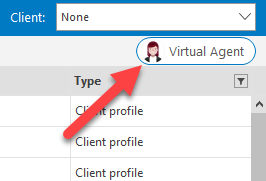
The virtual agent provides:
-
Direct descriptive answers to your queries based on our knowledge base articles, allowing you to benefit from an efficient virtual conversation 24 hours a day, 7 days a week.
-
The ability to chat with a live agent during business hours, so you can discuss your support cases with a person in real time.
-
The possibility of submitting a support case after consulting the list of proposed articles according to the nature of your query, which could provide the answers you are looking for before you even need to submit your support case.
Make sure you register for the Support Platform to access your requests and be able to follow up on them. We also invite you to watch this short video for everything you need to know about how the platform works: How to Manage Your Support Cases.
Reintroducing Telephone Support
As announced on February 18, 2026, you can now contact our support teams directly by phone Monday to Friday, from 10:00 a.m. to 5:00 p.m. (ET), when a live conversation is preferred.
Reintroducing phone support adds another way for you to engage with us, ensuring flexibility while maintaining the high level of service you expect.
To help you navigate the phone menu, we invite you to read the following article, which details all the available options: What are the phone menu options for 1-800-268-4522?
Digital support remains available
Our Knowledge Base, Support Platform, Virtual Agent, and Live Chat continue to provide convenient, efficient, and prioritized ways to get help.
Register for our Support Platform and log in to our virtual agent to find answers, submit a support ticket or chat with a live agent.
For more details about the web ticketing system and best practices, watch the following “How to” videos:
Useful support links:
More than 40,000 articles that answer the technical and tax questions most commonly asked to Support Centre agents.
We offer a wide range of useful videos on how the programs work and their most frequently used features.
Select your program and access the Taxprep help topics. You can also access the help topics by pressing the F1 key from within the program.
Support platform to request online support
Submit questions and requests through the virtual agent, support cases or live chat.
The support site brings together news, release documents, the Knowledge Base, the calendar of product release dates, the Download Centre, and more.
Contact the team that can meet your needs
Contact the team that can best meet your needs directly.
Taxprep e-Bulletin
For your convenience, you are automatically subscribed to the Taxprep e-Bulletin, a free e-mail service that ensures you receive up-to-date information about the latest version of Personal Taxprep. If you want to review your subscription to Taxprep e-Bulletin, visit https://support.cch.com/oss/canada and, in the Newsletter section, click Subscription Manager.
You can also register to our Support Platform at https://support.cch.com/oss/canada and submit a support ticket to indicate the products for which you wish to receive general information or information on our CCH software (Personal Taxprep, Corporate Taxprep, Taxprep for Trusts, Taxprep Forms or CCH Accountants’ Suite).
Training
To consult the different training options available regarding Personal Taxprep (seminars, webinars, tutorials and more), access the Training section of the Wolters Kluwer Web site. You can also access it from the program, by selecting Get Taxprep Training in the Help menu.
For Taxprep training, please contact the Professional Services team at learning@wolterskluwer.com.